
I couldn’t tell you what the point of photography is to me. I don’t know. But I do know what it isn’t; it’s not about capturing an objectively accurate image of reality. I’m not trying to record a time and place. I’m trying to record a feeling.
Such is the struggle and surprise of shooting on film, particularly with old cameras. The unfamiliar lenses of dubious quality, the questionable focus of the viewfinders, the physical randomness of film itself — not knowing if any of it will work only magnifies the meaning if you actually obtain an interesting result.
So what if there was a camera that was even more unreliable than any common 35mm SLR? Lol.

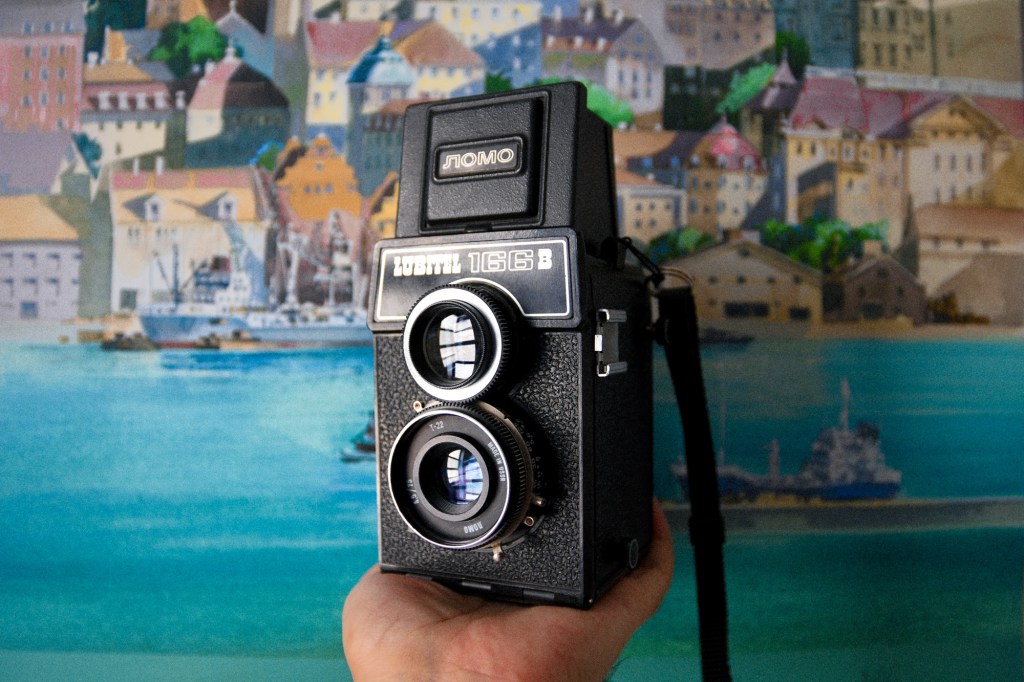
That is in part what interested me in the Lomo Lubitel 166B. The Lubitel is a medium format camera (“120 film” — about 60mm wide, very similar to an IMAX camera). It was manufactured in Russia since the 1950s; the 166 was the last model, made until the late 80s. The body is mostly plastic and has no electronics.
It is from this camera manufacturer — Leningradskoye Optiko-Mekhanicheskoye Obyedinenie, or LOMO — that ‘lomography‘ gets its name.
But I had always thought that medium format cameras were absurdly expensive, like the Hasselblads that NASA sent to the moon. Like anything, though, there are the high and low ends, and you can spend as much or little as you want. I chose little. I got this Lubitel from a seller in Ukraine for about fifty dollars. (Which means, I would guess, that you could probably find them for twenty bucks over there.)
It’s a twin-lens reflex camera, which means that it has two lens: one that you look through, and one that takes the picture. The lenses are mechanically linked so that when you focus one, you are focusing both. And you look down into the camera and shoot from the waist instead of holding it up to your eye.

And for those reasons, as well as its mass-produced, minimum-cost quality, the Lubitel 166 is notoriously difficult to focus. What, me worry?
It’s fairly easy to make the image look focused in the viewfinder. It even has a flimsy little magnifying glass that folds up so that you can refine your focus. Easy enough! I shot two rolls of film without knowing exactly what would happen.
Reader, it was not in focus. Pretty much only the higher F stops were sharp at all. Which was surprising, because I mostly left it focused at infinity, assuming most everything was far enough from the lens. Guess not! Infinity really meant infinity, or at least 10+ meters.

And it is also pretty strict about the 1.4 meter minimum focus distance. 1.4 meters is more than you’d think; in my mind that’s about one yard. Which is wrong, of course, as you can see here:

What I learned from those first two rolls was that being focused in the viewfinder didn’t mean much; you needed to rely on the estimated distance of your subject, and then focus based on the distance numbers printed on the side of the lens. But who knows how much 5 meters is? A great mystery.
The second batch of photos were better now that I knew not to trust focusing by eye.

All of the exposures were pretty good though. For the first two rolls I just used a phone app as a light meter. Which works fine. It’s a little annoying to pull out your phone every time.
Then I tried a little shoe-mounted light meter to simplify things. (The clip where you can mount a flash on a camera is called the shoe for some reason.) The meter works well, with the hilarious caveat that it is difficult to read in direct sunlight. It has little red and green LEDs that light up depending if you are over or underexposed. Sometimes you literally need to shade them with your hand to see what it says, though. Which is a very funny design flaw for a light meter. They also make LCD versions, like this one from Reflx Lab, but I liked the physical knobs on this one.

And the first time I loaded the camera I almost ruined the entire roll. I kept winding and winding it, trying to see the markings on the film through the tiny red window on the back of the camera through which you keep track of the film’s progression, until I realized I had wound through half of the entire roll. So I improvised a dark bag with some pillow cases and t-shirts under a blanket, opened the camera and unloaded the film, and then rewound it. Shockingly that worked and there weren’t any light leaks.
So does it capture the feeling of a scene? Lol. It’s fine, it works fine. It is always a surprise to get your film back from the development lab because there’s so much luck and happenstance involved. The giant, medium format film doesn’t really add much because the lens isn’t that sharp. It’s not a NASA camera. But it does have that expressionistic, dreamy quality that looks unlike any phone or SLR picture.
It feels stupid to say, but using the Lubitel is the fun part. Winding the film, popping the hood open, trying to focus and frame the shot even though you can barely see what you’re doing — all of that is what makes it worth using. Because none of the photos were that good, lol, but it was still a good time.

 cocopunk
Leave a reply to lll Cancel reply